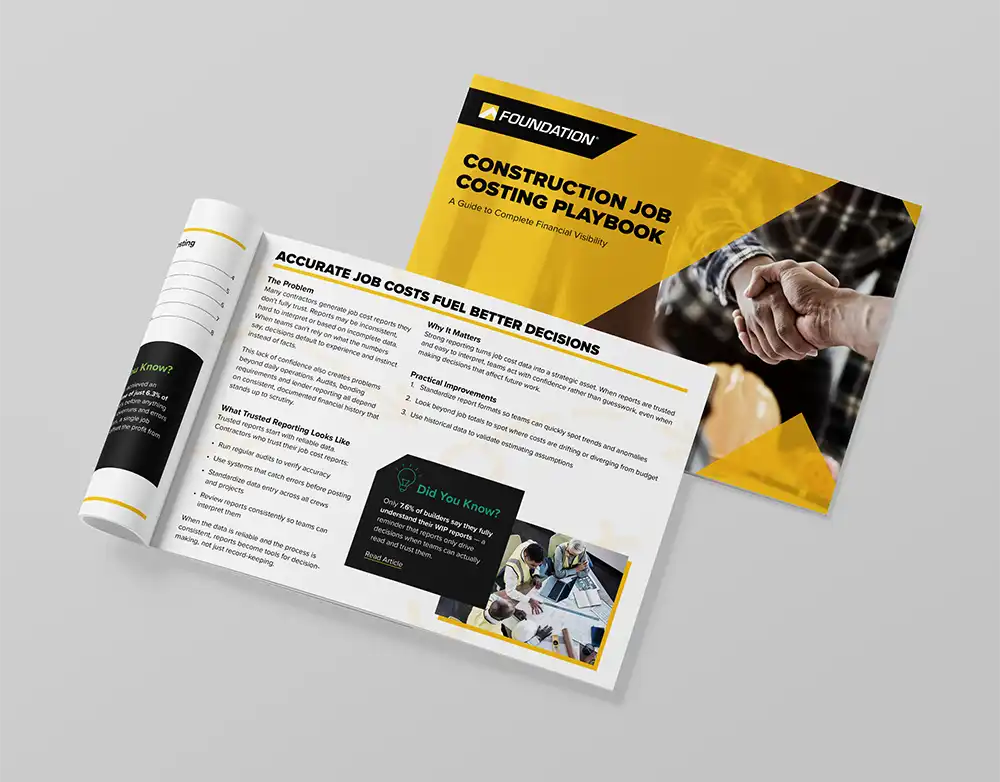
Does Your Job Costing Stack Up?

Get Your Results In Seconds

Take this quick 5-question quiz to get an instant job costing health score — plus actionable insights to help you move from tracking costs to making smarter decisions with them.
Question #1:

Real-Time Visibility

True or False:
I can see accurate job costs while the job is still in progress — not weeks later.

Image
Question #2:

Field Tracking

How do you capture field production and job progress — so production issues show up before payroll runs?

Image
Question #3:

Payroll & Job Costing Connection

True or False:
Labor data is validated before payroll runs and flows directly into job costs.

Image
Question #4:

Cost Tracking & Overrun Prevention

How do you capture field production and job progress — so production issues show up before payroll runs?

Image
Question #5:

Reporting Confidence for Future Bids

True or False:
I trust our job cost reports are accurate enough to use when bidding future work.

Image

Your Job Costing Health Results:

A / A+ — Job Costing in Control

You have strong, real-time visibility into your job costs — and you’re using it to your advantage.

Your processes support timely insight into labor, costs and profitability while jobs are still in progress. This puts you in a position to:

  • Catch issues early and correct course
  • Protect margins as jobs evolve
  • Confidently bid future work using accurate historical data

What to watch: Even strong job costing can slip as your business grows. More crews, jobs and payroll add complexity, and small gaps can quietly turn into blind spots without a scalable accounting system.

See how contractors maintain A+ job costing as they scale!

B — Mostly in Control, Some Blind Spots

Your job costing works — but not always when you need it most.

You have access to job cost data, but delays, manual steps or limited accuracy may delay insights. That means issues can surface later than ideal, after margins are already impacted.

What contractors at this level often experience:

  • You’re often reacting to issues instead of adjusting in real time
  • Labor or cost overruns may not surface until after billing or payroll
  • Reports are trustworthy, but not fast enough to drive daily decisions

The good news: With a few targeted process improvements, you can move from “mostly informed” to fully in control.

See the key changes that can move your job costing from B to A+!

C — Reactive Job Costing

You’re managing jobs with limited visibility into what’s really happening financially.

Your job costing relies on after-the-fact updates, spreadsheets or disconnected systems. As a result, profit fade and cost overruns are often discovered after they’ve already impacted the job.

Common risks at this stage:

  • Labor costs aren’t fully understood until payroll is complete
  • Project managers rely on delayed or manual reports
  • Decisions are made without a complete financial picture

Many contractors at this stage believe jobs are profitable — until year-end adjustments reveal otherwise.

See how you can stop profit fade and boost your job costing to an A+!

D — Financially Blind

You don’t have reliable visibility into job costs while work is happening.

Job costing data is delayed, inconsistent or disconnected from payroll and field activity. This makes it extremely difficult to:

  • Catch overruns early
  • Understand true job profitability
  • Confidently bid for future work

What this often leads to:

  • Surprise losses at job closeout
  • Manual rework and payroll errors
  • Decisions based on incomplete or outdated information

The good news: This is common — and it is fixable with the right processes and tools.

See how contractors regain control of job profitability.

F — Financially Blind

You don’t have reliable visibility into job costs while work is happening.

Job costing data is delayed, inconsistent or disconnected from payroll and field activity. This makes it extremely difficult to:

  • Catch overruns early
  • Understand true job profitability
  • Confidently bid for future work

What this often leads to:

  • Surprise losses at job closeout
  • Manual rework and payroll errors
  • Decisions based on incomplete or outdated information

The good news: This is common — and it is fixable with the right processes and tools.

See how contractors regain control of job profitability.

See What A+ Job Costing Looks Like in Action

Improving job costing doesn’t require guesswork — it requires the right structure, visibility and connected systems. See how FOUNDATION® construction accounting software helps contractors turn job costing into a tool for decision-making, not just record-keeping.