

Read Time: Less than 7 Mins
First Published: February 25, 2026
Picture this: it’s the end of 2025 and you’re reviewing your year-end financials.
You’ve wrapped up several major projects, your crews stayed productive and overall, your margins look steady.
The industry, however, is grappling with significant labor challenges.
According to the Associated Builders and Contractors (ABC), the construction industry will need to attract nearly 500,000 new workers in 2026 just to keep pace with demand, intensifying the pressure on already strained operations.
This skilled labor shortage intensifies the need for existing teams to work smarter and more efficiently.
But as you navigate through the first few months of 2026, some familiar questions surface:
- Will material pricing stay volatile?
- Will labor shortages and rising wages continue?
- How will new reporting requirements impact the back office?
- And how much data will contractors really need to stay competitive next year?
These are questions nearly every construction business is asking — because the industry is shifting quickly, and accounting teams are feeling the pressure to keep up.
While discussions about AI construction accounting and automation continue to rise, many contractors are looking for something more immediate: better visibility, tighter controls and tools that help them stay ahead of fast-moving financial challenges.
As 2026 plays out, the future of construction accounting isn’t about replacing people with technology — it’s about giving teams stronger insights, clearer data and more dependable systems to make confident financial decisions.
And the contractors who focus on strengthening these fundamentals will be in the best position to succeed.
Key Takeaways for Construction Professionals:
- The most successful contractors in 2026 will focus on strengthening their foundational accounting practices — specifically, accurate job costing and tightening internal controls — rather than chasing every new AI trend
- To navigate ongoing industry volatility, rely on real-time financial reporting for quick decision-making, moving away from outdated spreadsheets and month-end reviews
- Utilize automation to streamline time-consuming back-office tasks, such as invoice approvals and payroll processing, freeing up the accounting team to focus on high-value tasks
- Ensure all your software platforms seamlessly eliminate duplicate data entry, reduce errors and maintain a single source of truth for project performance
The 2026 Shift: Visibility and Accuracy Over Everything
If 2025 was the year of uncertainty — fluctuating costs, supply chain changes and tracking labor challenges — then construction accounting in 2026 prioritizes real-time visibility and job-level accuracy to protect contractor profitability.
Contractors want to know:
- Where their money is going
- Whether they’re billing enough
- How accurate their budgets actually are
- Where profits are at risk on every job
While buzzwords like predictive analytics and automation are everywhere, the foundation of future-ready accounting is surprisingly straightforward: accurate construction job costing, up-to-date numbers and centralized data.
This means 2026 won’t just favor the companies chasing the newest trend.
It will favor the companies that tighten their internal controls and use accounting tools that give them a real-time view of project performance.
AI Is On the Horizon — But Strong Data Comes First
AI is becoming a major talking point in construction finance, especially around cost overrun prediction, automated coding and advanced analytics.
While many of these features are still emerging across the industry, contractors can prepare now by strengthening the fundamentals — job costing accuracy, clean reporting structures and connected financial data.
Those habits create the foundation needed to take advantage of AI-driven tools as they mature.
Why Real-Time Financial Data Will Matter More Than Ever
Real-time financial reporting strengthens construction accounting decisions by reducing delay-driven cost overruns.
One of the biggest trends in 2026 is the growing demand for real-time reporting — not because it’s flashy, but because delays cost money.
Contractors are moving away from:
- Waiting until month-end to review performance
- Working from outdated spreadsheets
- Making decisions without current job-level data
- Guessing at cash flow instead of tracking it
And they’re leaning into:
- Up-to-the-minute job cost updates
- Live WIP visibility
- Faster billing cycles
- Quick access to over/under construction reports
While the industry continues to talk about advanced analytics and cost overrun prediction, contractors are increasingly focusing on what can be controlled right now: having reliable, detailed project data available when they need it.
If 2026 brings another year of unpredictable pricing and labor swings, real-time data won’t just be convenient — it will be essential.
Automation Will Continue to Streamline the Back-Office

Automation isn’t new, but in 2026 its role expands in practical ways that support accounting teams directly.
In construction accounting, automation improves efficiency by eliminating manual approval and payroll bottlenecks.
Contractors are relying more heavily on automated processes to handle tasks that used to consume hours, like:
- Routing invoices for approval
- Updating WIP schedules
- Managing complex payroll processing requirements
- Tracking retainage
- Pulling cost reports
- Syncing field and office data
The goal isn’t to replace the accounting team — it’s to give them back the time they need to focus on accuracy, compliance and profitability.
And as conversations continue around analytics for contractors and AI-driven workflows, many firms are realizing that automation paired with solid accounting processes may be the best combination for improving financial reliability in the near term.
Integrations Will Play a Bigger Role in 2026
System integrations reinforce construction accounting accuracy by synchronizing job cost, payroll, and project data.
Construction firms rely on more systems than ever — estimating, project management, payroll, HR, field tools, time tracking and more.
But when these platforms don’t communicate, mistakes happen. Numbers drift. Data duplicates. Reports lose accuracy.
That’s why integrations will be a major focus in 2026.
Contractors want connected data, not siloed systems. They want:
- Actuals feeding into construction accounting software without re-entry
- Timecards syncing directly to job costing
- Construction budgets flowing in from estimating
- Project data updating automatically
Strong integrations mean fewer errors, faster reporting and better decision-making — all critical in a year where financial precision will matter more than ever.
How Contractors Can Succeed in 2026
As construction companies look ahead, here are key steps leaders can take to strengthen their financial operations:
- Tighten Job Costing Processes: Strengthen how costs are tracked at every phase of a project to improve forecasting accuracy, reduce surprises and ensure profit expectations stay aligned with real-world performance.
- Evaluate Reporting Needs: Make sure your teams have quick access to real-time financial reports and job data so they can spot issues early, make informed decisions and keep projects on track.
- Standardize Billing Workflows: Create consistent, repeatable construction billing practices to reduce delays, support healthier cash flow and ensure each project’s financial activity stays organized and predictable.
- Review Integrations Across Your Tech Stack: Confirm that your estimating, project management, field tools and accounting data flow seamlessly to minimize re-entry, eliminate errors and improve operational efficiency.
- Strengthen Budget-to-Actual Comparisons: Use more accurate, up-to-date cost and revenue data to measure job performance, identify overages sooner and keep projects financially aligned from start to finish for better budgeting.
These aren’t futuristic strategies — they’re practical moves that help contractors prepare for larger industry shifts.

Where FOUNDATION® Fits Into Your Future
While the industry continues exploring emerging trends like AI-driven forecasting, predictive modeling and advanced analytics, contractors don’t need to wait for the “next big thing” to strengthen their financial strategy for 2026.
The most prepared teams will be the ones combining awareness of new technology with the proven tools already delivering results today.
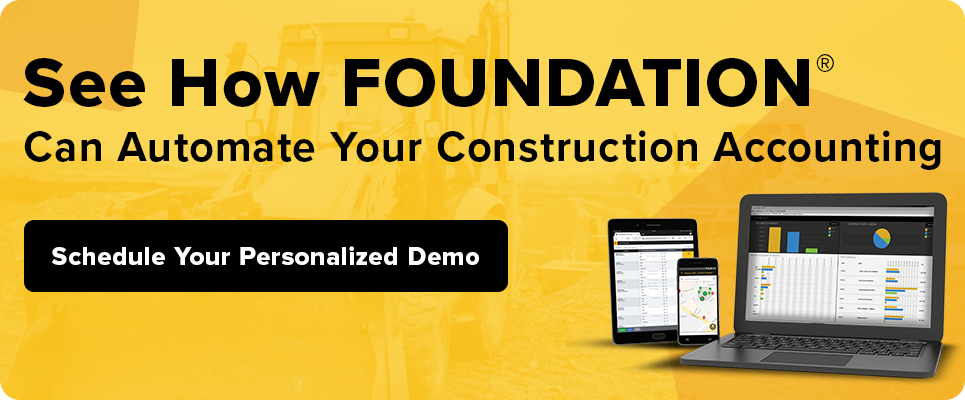
That’s where FOUNDATION construction accounting software plays a crucial role.
With powerful job costing, robust reporting, WIP analysis, construction payroll, and real-time financial visibility, contractors can build the clarity and consistency required to navigate whatever 2026 brings.
FOUNDATION also offers seamless integrations across your project, operations and field solutions, helping teams streamline data from estimating, project management, time tracking and more — all in one connected financial system.
And for businesses tightening spending controls heading into the new year, FOUNDATION Pay, the platform’s connected expense and pay management solution, provides instant job-costed transactions, simple mobile receipt capture, built-in spending controls on every card and faster month-end processing through fully coded transactions pushed directly into your books.
By combining strong financial processes with technology that keeps your data clean, connected and transparent, contractors can stay resilient — even as the industry continues evolving with AI-driven capabilities and digital transformation.
Chat with a specialist today to learn more about how FOUNDATION can help you prepare for what’s next.
Share Article
Make Your Inbox Smarter
Keep on current news in the construction industry. Subscribe to free eNews!
Related Articles

Create Custom Construction Reports With FOUNDATION® and DataGenie™
Construction accounting generates an enormous amount of data. Job costs, labor, equipment, billing, compliance and reporting all flow through the
Learn More

The Advantages of Working With a Construction CPA Firm
Construction companies don’t struggle with finances because they lack discipline — they struggle because construction is fundamentally different from other
Learn More
Our Top 3 YouTube Videos
Learn about our software more in depth with product overviews, demos, and much more!
ACA & W-2 Services
Our ACA reporting & e-filing services include official 1094-C and 1095-C IRS reporting, optional e-filing (no applying for a TCC code required), mailing to your employees and experienced support to help you.

Client Testimonials
There are plenty of reasons to make FOUNDATION your choice for job cost accounting and construction management software — just ask our clients!
Product Overviews
From job cost accounting software, to construction-specific payroll. Get an overview on your next all-in-one back-office solution.